
Do electrolytes break your fast? What you actually need
The additives are what break a fast, not the minerals. And the one most people skip is the one that put me on the floor.
If you've started fasting, you've seen "electrolytes are critical" everywhere. Then you pick up a packet, notice it has calories or some sweetener in it, and freeze, because now you're worried it'll break your fast. Meanwhile plain water is leaving you with headaches and that lightheaded, drained feeling. So which is it?
Let me answer it from the inside, because I learned this one the hard way.
What actually breaks a fast
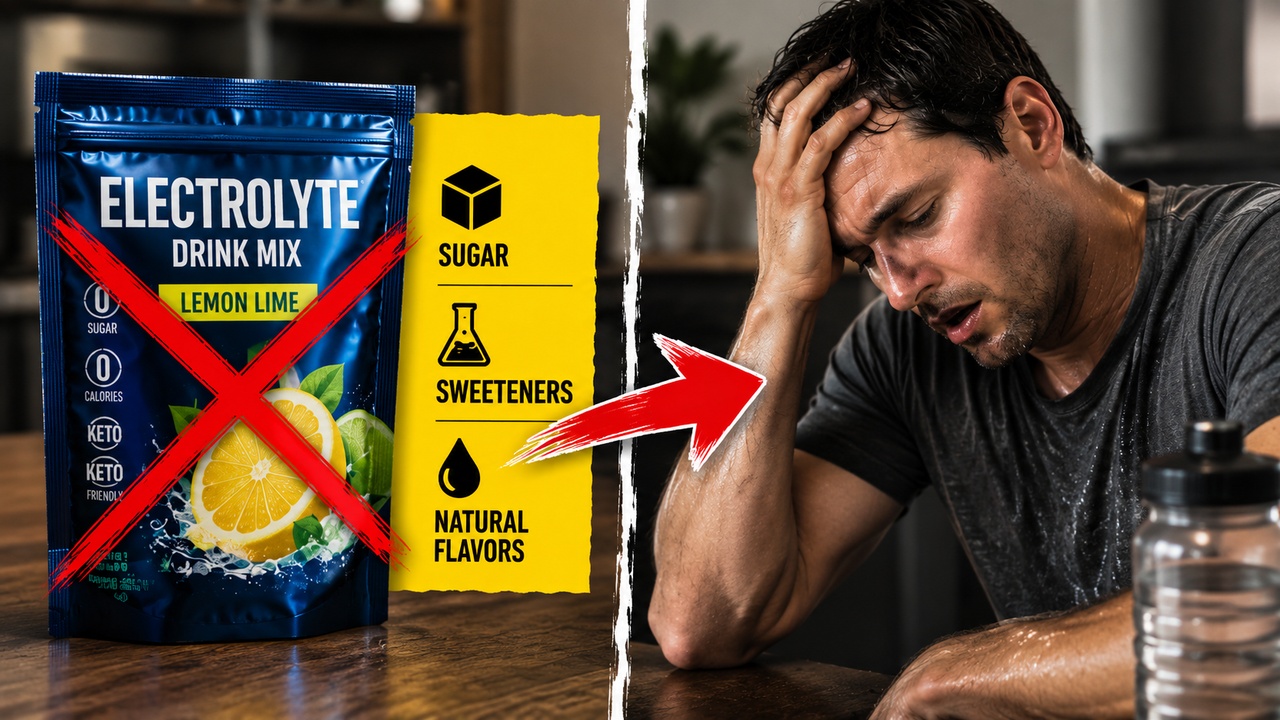
The electrolyte market is huge, and here's the problem with most of it. It isn't the minerals that break your fast. It's what they pack around them, the sugar, the aspartame, the fake sweeteners, all the flavors that make it taste like a sports drink. That's the part that breaks it. The sodium, potassium, and magnesium themselves are not the issue.
So I went purist. I don't care how it tastes. All I know is my body likes it, needs it, and runs better on it, and that's all that matters to me. A lot of these products are all packaging and marketing and don't deliver on the actual ingredients, so I'd rather break it up myself.
The three that matter, and the one everyone forgets
Think of magnesium, potassium, and sodium as your body's lubrication. They're the core essentials, the building blocks that keep everything moving. I take them separately now, not as one commercial electrolyte packet, because most of those are lower than I actually need. Those are fine for casual use, after sport, that kind of thing. They're not enough for real fasting.
Potassium is the sneaky one. You need a large amount of it, and you genuinely cannot eat your way to enough, especially while you're fasting. Not because fasting is draining it, but because you can't produce or consume enough of it. That makes it the one that quietly slips into deficiency while you're not looking.
I know that because it happened to me twice over. First, deep in a run of 65-hour fasts, I got so focused on the protocol that I neglected my hydration and electrolytes, and I had a hypoglycemic event. Nearly passed out, couldn't make it to bed, had to lie down on the floor right where I was. A big bolus of salted water and a couple of low days later, I came out of it. The lesson wasn't really about electrolytes. It was about orchestration. You cannot lock onto one pillar and neglect another.
Then, seven or eight months later, it came back around. I'd started getting spasms in my legs and across the top of my feet, and a couple of heart palpitations. And I knew that feeling. I traced it back, because I keep track, and it was the potassium again. That original event had drained me, and somewhere along the way I'd drifted back to just salt and magnesium and quietly dropped the third piece. Months later it caught up with me. These things creep in, and if you've stopped tracking and stopped listening to the signs, that's exactly where the problems start.
What I actually do now
Early on I salted everything with sea salt, not the iodized stuff, because sea salt also brings trace minerals with it. I still salt to taste based on what I'm eating. Beyond that I supplement the three separately, magnesium, potassium, and sodium, so I can adjust one against the others and find the balance that works for me. Magnesium does double duty for me anyway, for the cardiovascular side and to help with stress and sleep, so it's in the rotation whether I'm fasting or not.
A quick, honest caution on potassium. It's powerful, and it is not something to load up on off a stranger's advice, including mine. Do your own research, understand why you're taking it, and figure out your own needs. I'm telling you what I do, not writing you a prescription.
The takeaway
You don't need the fancy flavored packet, and you shouldn't fear that electrolytes break your fast, because it's the additives that do that. Keep it simple and clean. Sea salt to taste, and the three minerals covered, with an eye on the potassium that everyone forgets until it bites. And listen for the early signs, the cramps, the drained feeling, the odd palpitation, because your body will tell you long before it puts you on the floor.
~ Foster
By Foster
Questions people ask about this
Do electrolytes break a fast? The packets I see all have calories or sweeteners in them.
It is not the minerals that break your fast. It is what gets packed around them, the sugar, the aspartame, the fake sweeteners, all the flavoring that makes it taste like a sports drink. That is the part that breaks it.
So I went purist. I do not care how it tastes. My body needs it and runs better on it, and that is all that matters. A lot of these products are all packaging and marketing and do not deliver on the ingredients, so I would rather break it up myself and keep it clean.
Which electrolytes do I actually need on a fast, and can't I just get them from food?
Think of magnesium, potassium, and sodium as your body's lubrication. They are the core essentials that keep everything moving, and I take them separately now, not as one commercial packet, because most of those are lower than I actually need. Those are fine for casual use after sport, not for real fasting.
Potassium is the sneaky one. You need a large amount, and you genuinely cannot eat your way to enough, especially while fasting. That makes it the one that quietly slips into deficiency while you are not looking. A quick honest caution though: potassium is powerful, so do your own research and understand your own needs rather than loading up on anyone's advice, including mine.
How do I know if I'm running low on electrolytes while fasting?
Your body will tell you well before it puts you on the floor. Headaches and that lightheaded, drained feeling on plain water are early ones. Cramps or spasms, and the odd heart palpitation, are louder ones.
I learned this twice. Once deep in a run of long fasts when I neglected my hydration and electrolytes and nearly passed out. And again months later, when spasms in my legs and feet and a couple of palpitations turned out to be low potassium that had drifted back in while I was not tracking it. The lesson is to keep track and listen to the signs, because these things creep in quietly when you stop paying attention.