
What 400 miles in your head means for how you age
Brain plumbing has more to do with how you age than most of us realize. The science of vascular dementia, the surprising plot twist with Alzheimer's, and what shows up on the kitchen counter to keep the plumbing healthy.
For something we depend on minute by minute, blood vessels are an oddly invisible part of our story. We talk about hearts a lot. We talk about brains a lot. We rarely talk about the plumbing that connects them. And yet 400 miles of it threads through your brain alone.
That number stopped me when I first heard it. The kind of detail you can't unsee. Four hundred miles of vessels, capillaries, arterioles, venules, laid through brain tissue that occupies less than three pounds of body weight. Every minute of every day, that network is delivering the oxygen and nutrients your cognition runs on. Stop the flow for a few seconds and a person faints. Slow it gradually over decades and the brain begins to fade in ways most people misread.
This piece is about what that fading actually is, why food shows up as medicine in this story (not as a slogan, as biology), and what to do with that on a Tuesday afternoon.
The fading we usually call by the wrong name
When most of us picture cognitive decline, a single word comes up: Alzheimer's. It's become the placeholder term for "memory not working anymore." The trouble is that dementia, the umbrella term for impaired cognition, has more than one cause, and Alzheimer's is only one of them. The other big category, often quieter and more common, is vascular.
Vascular dementia is what happens when those 400 miles of brain plumbing start to narrow, harden, or clog. Picture a sprinkler system on a hot lawn. Cut the supply line in three places and patches start dying. The brain doesn't dramatize the loss the way a stroke does. The loss is gradual, the effects are diffuse, the person becomes a slightly slower version of themselves before becoming a more obviously different version. By the time the words cognitive impairment show up at a doctor's visit, the plumbing has often been struggling for years.
This matters because vascular dementia is the more preventable kind. The risk factors that age your blood vessels in your legs and your heart age them in your brain too. High blood pressure, blood sugar that doesn't fully clear, smoking, poor sleep, sedentary years stacking up. None of those are dementia in their own right. All of them are arguments for keeping the plumbing healthy.
Where food comes in (and not as a slogan)
For most of human history, food was the medicine. There were no pharmaceuticals before the 1930s. Diet and lifestyle were what people had, not because they were romantic about it, but because there were no other tools. The pharmaceutical revolution gave us extraordinary new tools, and that's a real win. The catch is that the older tool, what's on the plate, got set down somewhere along the way. Not lost. Just unattended.
The newer science is what makes putting it back in the toolbox interesting. We now have the same kind of mechanism-level detail for foods that we have for drugs. We can ask: what is dark chocolate actually doing in the body? and answer it with biology, not lore.
Here's an example that ties directly to those 400 miles in your head.
A handful of foods, dark chocolate (specifically the cacao), beetroot, leafy greens like spinach, share a common downstream effect. They help your body produce more nitric oxide. Nitric oxide isn't a vitamin or a mineral. It's a small signaling molecule that tells your blood vessels to widen. Wider vessels mean better blood flow, including in the brain. Year over year, that's an argument for why the people who quietly include these foods on their plate tend to age their cardiovascular system more gently than people who don't.
The second-order effect is the part that surprised me. When nitric oxide goes up, it recruits stem cells from your bone marrow. Primitive cells that can become whatever the body needs to repair. Including, in this case, the cells that keep blood vessels healthy. So the food does more than relax the existing plumbing. It helps the body grow and maintain new healthy plumbing.
That's not a metaphor. That's the mechanism.
The plot twist with Alzheimer's
For a long time, the assumption with Alzheimer's brains was that they had less blood flow because they had fewer blood vessels. The vessels died off, the brain starved, the disease progressed. That picture made intuitive sense.
The actual picture, as it turns out, is stranger. Alzheimer's brains have more blood vessels than healthy brains. But they're abnormal. They don't carry blood the way healthy vessels do. So scans still show poor flow, not because vessels are missing, but because the vessels that are there aren't working. And here's the harder part. Those abnormal vessels appear to secrete a neurotoxin that kills brain cells. They also seem to release a precursor that helps build the protein plaques Alzheimer's is named for.
This was published as a hypothesis years ago in The Lancet. It opened a research thread that's still active. From a layperson's perspective, the takeaway isn't "we've solved Alzheimer's." It's that the plumbing story matters even more than we used to think. Because the plumbing isn't just about delivering oxygen, it's about whether the vessels themselves are growing in a healthy or unhealthy way.
That growth process has a name: angiogenesis. The body builds new blood vessels all the time. Done well, it's how you heal a cut, how a marathon runner expands capillary density in their legs, how the brain stays well-fed across decades. Done poorly, it's how tumors get a blood supply, and how the wrong kinds of vessels show up in an aging brain.
So the question food keeps trying to answer, quietly, biochemically, is what tilts angiogenesis toward the healthy version?
What this looks like at the kitchen counter
This is the part where I have to resist the urge to write a list. Lists feel like prescriptions. Prescriptions feel like a diet. Diets, in my experience, are the fastest way to stop loving food.
Instead, let me tell you what tends to land on my counter on a normal week, anchored to this story:
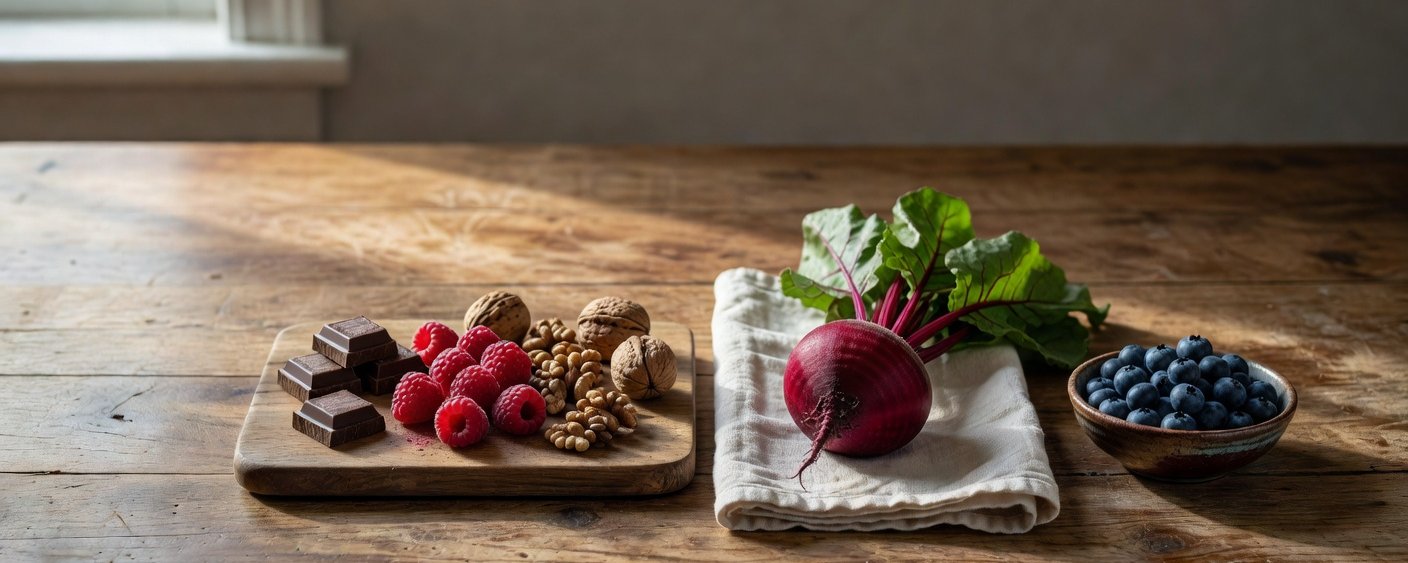
Berries. Raspberries pound for pound are one of the most fiber-rich foods you'll find. They're hollow inside, packed with structure. Blueberries and strawberries bring polyphenols that quiet inflammation, which is itself a vascular story. Berries are an easy one because most people already love them.
Dark chocolate. Real chocolate, the kind where cacao is the first ingredient. Not dessert chocolate. A square or two as a deliberate ritual, not a stress response. The cacao polyphenols are what drive the nitric oxide effect.
Leafy greens. Spinach is the headline here for the nitric oxide story, but bok choy, kale, chicory, escarole all earn their seats. The Mediterranean and East Asian cooking traditions have spent centuries figuring out how to make leafy greens taste like something you actually want to eat. Borrow from both.
Tree nuts. Walnuts, almonds, macadamias, pistachios. Roasted at home, not the pre-packaged version. Fiber, healthy fats, protein, and the kind of flavor that makes them feel like an indulgence even though they're working hard for you.
Beets and tomatoes. Beets for the nitric oxide story, tomatoes for lycopene and a metabolic story we'll save for another piece.
Coffee in the morning, tea at night. Both bring polyphenols. Both are habits most of us already have. Anchoring the habit you already have to the science you're now aware of is one of the easier wins.
That's not a meal plan. It's a kitchen orientation. Most of those foods are probably already in your shopping rotation. The shift is to notice them differently. As the tool that was always there, now backed by mechanism.
Where supplements fit
The honest answer on supplements is that they should top off, not replace. The word supplement literally means "in addition to," and food is the more efficient delivery system for the hundreds of compounds you actually need. A whole tomato delivers more than a lycopene capsule. A handful of walnuts delivers more than a fish oil softgel.
That said, three things are hard to get enough of from food alone for most people. Vitamin D (we're not outside enough), omega-3s (most diets don't include enough fatty fish), and a few targeted probiotics where the data is meaningfully ahead of the food source.
I won't tell you which supplements to take. I'll tell you what the question is. What am I genuinely under-getting from my food, and is the data on the supplement strong enough to fill the gap? If the answer is yes, top off. If the answer is "I'm hoping it helps," save the money and re-orient your plate.
The part I want to land on
If you walk away with one thing, it's this. The people who maintain healthy brain plumbing into their seventies and eighties aren't usually following a perfect diet. They're following a diet they actually like, that happens to include a lot of the foods this story is about, eaten consistently across decades. The consistency is what compounds. The enjoyment is what makes consistency possible.
So pick the foods on this list, or any list of well-evidenced everyday foods, that you already love. Start there. Build the habit around what already brings you to the kitchen. The biology takes care of itself when the choices are easy enough to repeat.
Four hundred miles of plumbing in your head will thank you for it, quietly, over the years you don't notice it.
~ Foster
By Foster